On this page (7 sections)
Who should skip this?
Skip this comparison if you already chose self-custody, or you wanted a protocol tutorial. It contrasts banks with smart contracts. It will not tell you where to put next month's rent.
- You wanted Aave vs Compound
- You needed regulated financial advice
- You have no interest in self-custody
The Core Difference Between DeFi and TradFi
Traditional finance is built on trusted intermediaries: banks hold deposits, brokers execute trades, clearinghouses settle transactions, and regulators oversee the system. Every step involves an institution that charges fees, verifies identity, and holds the power to approve or deny access.
DeFi replaces these intermediaries with smart contracts — open-source code deployed on public blockchains that execute financial functions automatically. Lending, trading, yield generation, and governance all happen through code with no human approval required.
Neither system is objectively superior. They carry genuinely different trade-offs suited to different needs, risk tolerances, and financial circumstances.
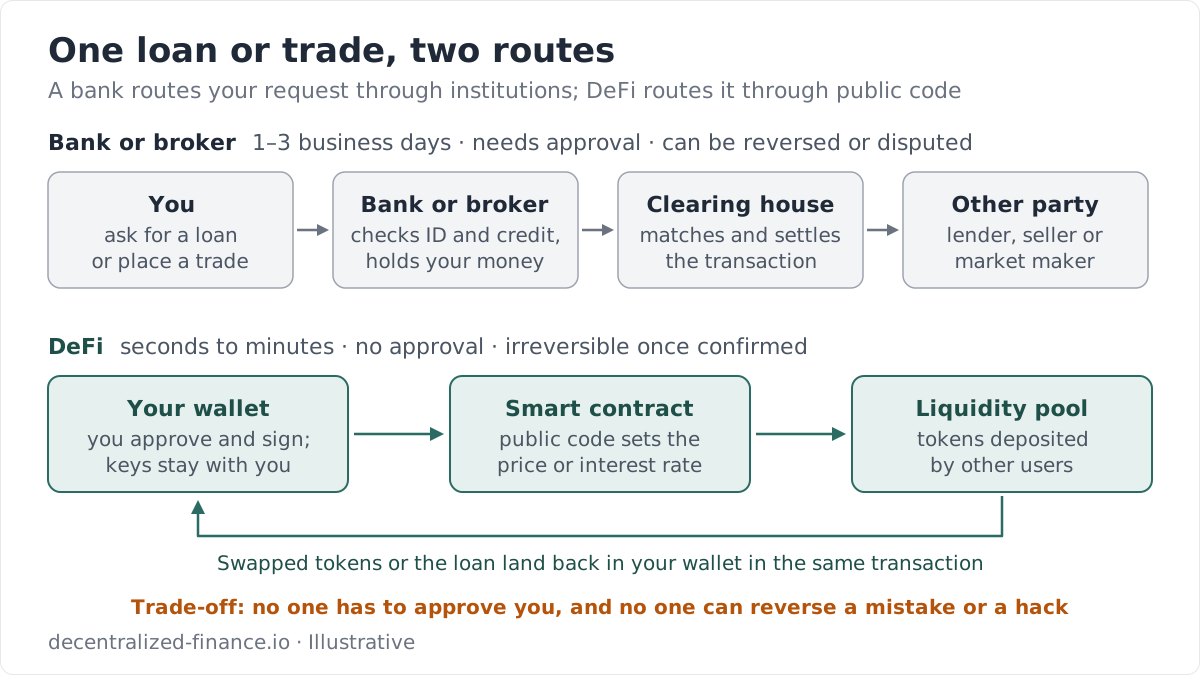
DeFi vs Traditional Finance: Full Comparison Table
| Feature | DeFi | Traditional Finance |
|---|---|---|
| Custody | Self-custodial — you hold your own private keys | Custodial — institutions hold your funds |
| Access | Permissionless — anyone with a wallet and internet | Requires ID, credit check, minimum balances, geography |
| Transparency | Fully public — all transactions and code visible on-chain | Opaque — internal operations not visible to customers |
| Transaction speed | Minutes (seconds on Layer 2 networks) | Seconds (UK Faster Payments) to days (international wires); T+1 (US) or T+2 (UK/EU) for securities |
| Opening hours | 24/7/365 — no market closures | Securities markets and some payment systems (e.g. CHAPS) keep business hours; UK Faster Payments runs 24/7 |
| Fees | Gas fees + protocol fees (typically 0.05–0.3%) | Account fees, commissions, FX charges, spreads |
| Interest rates | Market-determined in real time | Set by the institution; typically below market for savers |
| Consumer protection | None — no FSCS equivalent, no chargeback | FSCS protects eligible UK deposits up to £120,000 per person, per banking licence (since 1 December 2025) |
| Identity required | Pseudonymous — no KYC required | Full KYC/AML identity verification required |
| Transaction reversibility | Irreversible once confirmed on-chain | Chargebacks, fraud protection, and dispute resolution available |
| Regulation | Largely unregulated; FCA framework evolving | Heavily regulated; FCA authorisation required for financial services |
| Composability | Protocols interoperate freely — 'money legos' | Systems are siloed; limited interoperability between institutions |
Where DeFi Has a Clear Advantage
Access for the unbanked is DeFi's most powerful structural advantage. About 1.3 billion adults worldwide still lack an account at a bank or mobile-money provider (World Bank Global Findex 2025) — due to lack of documentation, geographic remoteness, or minimum balance requirements. DeFi protocols are open to anyone with a smartphone and internet connection, regardless of nationality, credit score, or wealth.
Yield on savings in DeFi is more transparent than traditional banking, but not reliably higher. With the Bank of England's Bank Rate at 3.75% (September 2026), UK savings rates sit around that level, and supplying USDC to Aave paid about 3.5–4% in September 2026 — comparable and variable. The Aave rate is market-determined by supply and demand, visible on-chain to everyone and updated in real time.
Transparency is structurally superior in DeFi. All protocol code is published on-chain. All transactions are publicly verifiable. Any user can audit how a protocol works, verify its solvency, and monitor every loan and trade. Traditional banks are closed books — customers cannot examine loan portfolios, investment strategies, or fee structures.
International payments are dramatically faster and cheaper. Sending $10,000 USDC globally via Ethereum or Solana takes minutes and costs cents. An international bank wire transfer can take 3–5 business days and cost $25–50 in fees.
Where Traditional Finance Has a Clear Advantage
Consumer protection is the strongest argument for traditional finance. In the UK, the Financial Services Compensation Scheme (FSCS) protects eligible bank deposits up to £120,000 per person, per banking licence (the limit rose from £85,000 on 1 December 2025). If your bank fails, FSCS compensates you. In DeFi, if a protocol is hacked or collapses, there is no equivalent protection — funds are typically unrecoverable.
Dispute resolution and reversibility protect consumers from fraud and error. Credit card chargebacks, bank fraud teams, and wire transfer recalls can recover stolen funds in many situations. In DeFi, transactions are irreversible — sending to the wrong address or falling victim to a phishing attack results in permanent loss.
Regulatory compliance provides legal certainty and accountability. Regulated institutions must comply with AML rules, consumer protection laws, and capital adequacy requirements, creating a predictable and legally enforceable environment for most financial activities.
Sources
Primary documentation and data this guide relies on. Links checked .
- See how FSCS protects banks, building societies and credit unions — FSCS. Consumer-protection comparison: FSCS protects bank deposits up to £120,000 per person, per bank
- Crypto: The basics — UK FCA. DeFi column: no FSCS equivalent or compensation for crypto losses
- A new regime for cryptoasset regulation — UK FCA. Regulation row: UK crypto framework still evolving
- What is DeFi? Benefits and use of decentralised finance — ethereum.org. DeFi column: open access, always-open markets, pseudonymous activity
- Digital technology is unlocking financial inclusion — World Bank. Access for the unbanked (Global Findex 2025 figure)
- CRYPTO61214 - DeFi lending and staking: nature of the return — HMRC. UK tax FAQ: how DeFi lending/staking returns are taxed
Frequently asked questions
Is DeFi safer than a bank?
They carry different risks. A UK bank deposit up to £120,000 (per person, per banking licence, since 1 December 2025) is FSCS-protected — if the bank fails, you are compensated. DeFi carries smart contract risk, protocol collapse risk, and user error risk with no equivalent protection scheme. For amounts within FSCS limits, a regulated UK bank is generally lower-risk for savings. DeFi may be preferable for users seeking self-custody above the £120,000 FSCS limit or potentially higher yields, with full understanding of the technical risks involved.
Can DeFi replace banks?
DeFi can replicate specific bank functions — savings accounts, loans, currency exchange — but is not yet a complete substitute. Missing from DeFi: fiat on/off ramps at scale, mortgage lending, pension management, and consumer protection infrastructure. DeFi is more accurately a parallel financial system that complements traditional banking for users who choose to use it.
Do I pay tax on DeFi in the UK?
Yes. HMRC treats DeFi transactions as taxable events. Swapping tokens triggers capital gains tax. HMRC taxes DeFi lending and staking returns as income or capital depending on how the arrangement is structured — they are not automatically income. The government has announced 'no gain, no loss' rules, due to take effect from 6 April 2027, that will defer CGT when you put tokens into qualifying crypto loans and liquidity pools. HMRC's crypto guidance covers DeFi-specific scenarios including liquidity provision and lending. Keep records of all DeFi transactions for your Self Assessment return.
What is the biggest risk in DeFi?
Smart contract exploits are the largest structural risk — billions of dollars have been lost to code vulnerabilities in audited protocols. For individual users, the most common cause of loss is user error (sending to wrong addresses, losing seed phrases, approving malicious contracts) and falling for phishing sites. Starting with small amounts on established protocols significantly reduces risk.