On this page (7 sections)
Who should skip this?
Skip SparkLend if you do not already understand Aave-style health factors, you need many long-tail assets, or you only wanted the Sky Savings Rate — that is sUSDS at sky.money, not a Spark loan. Spark is a lending market, not a savings account.
- You have never supplied to Aave or Compound
- You need a long-tail collateral Aave lists and Spark does not
- You thought SparkLend and sUSDS were the same product
Should you use SparkLend or Aave?
Use SparkLend when you specifically want Sky's USDS/DAI-lineage rates and incentives on Ethereum. Use Aave when you want the default multi-chain lending market with more assets and more integrations. They share DNA — SparkLend is built on Aave V3 code — but they do not share governance.
If your only goal is to earn the Sky Savings Rate on USDS, you may not need SparkLend at all. That rate lives in sUSDS via sky.money. SparkLend is for supplying and borrowing inside a lending pool. Mixing the two products up is the usual beginner mistake.
What is SparkLend and how does it work?
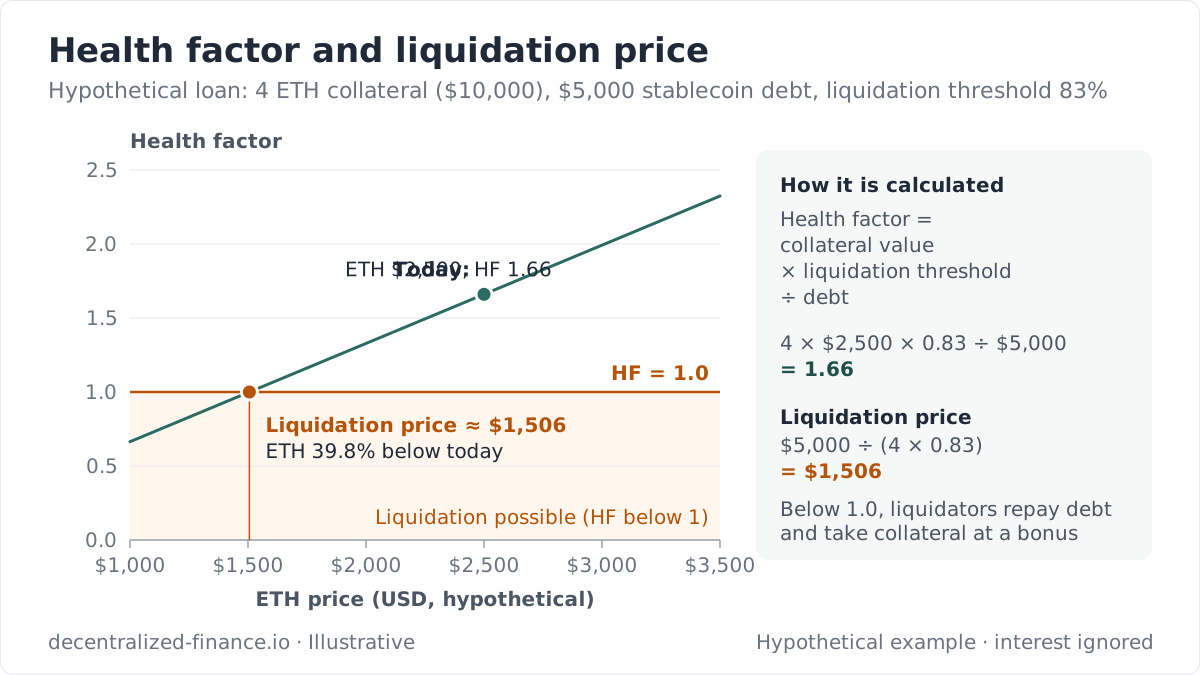
SparkLend is Sky Protocol's lending front-end: supply assets to earn a variable rate, or post collateral and borrow. Under the hood it uses Aave V3-style pools and aTokens (often branded spTokens). Isolation, eMode-like correlated borrowing, and liquidation at health factor 1.0 will feel familiar if you know Aave.
Sky can steer USDS liquidity via its D3M-style modules, which is why Spark sometimes shows subsidised USDS borrow rates Aave does not. That is a feature, not a free lunch: incentives can change under a live position. Official app: app.spark.finance on Ethereum mainnet — Spark migrated its domain from spark.fi to spark.finance (checked September 2026).
| Job | SparkLend | Aave V3 | sUSDS (Sky savings) |
|---|---|---|---|
| Supply / borrow pool | Yes | Yes, more assets/chains | No |
| Sky Savings Rate | No — different product | No | Yes |
| Governance | Sky | Aave DAO | Sky |
| Best for | USDS-centric users on Ethereum | General-purpose lending | Idle USDS yield without a loan |
How do you supply and borrow on SparkLend?
Treat it like Aave: connect a wallet on Ethereum, supply, optionally enable collateral, then borrow only if health factor stays comfortably above 1.0. A first session should be supply-only.
- 01
Open app.spark.finance
Connect MetaMask or Rabby on Ethereum mainnet. Bookmark the official URL.
- 02
Supply
Choose an asset you already hold (ETH, USDC, DAI/USDS as listed). Approve the token, then supply. You receive a receipt token that accrues interest.
- 03
Skip borrow on the first visit
Borrowing introduces liquidation. If you do borrow, enable collateral explicitly, draw a small amount, and keep health factor high.
- 04
Repay before you withdraw
You cannot withdraw collateral that is still backing a loan. Repay, then withdraw. Rates are variable — they are not the Sky Savings Rate.
If you only wanted yield on USDS with no loan, open sky.money for sUSDS instead of forcing a SparkLend position.
The verdict: should you use SparkLend?
Yes, if you are already in the Sky/USDS stack on Ethereum and you understand Aave-style liquidations. No, if you need Aave's asset list and chain coverage, or if you have not yet done a simple supply on Aave. Spark is a specialist fork, not a replacement for learning the generic lending flow.
Compare Aave vs Spark on our comparison pages before moving size. For live APYs across lenders, use the tools page — those figures are DeFiLlama snapshots, not guarantees.
Sources
Primary documentation and data this guide relies on. Links checked .
- SparkLend — Spark documentation. SparkLend is Spark's Ethereum money market under Sky governance; Spark steers USDS liquidity into it
- Security Audits — Spark documentation. SparkLend is built on Aave V3 code
- spToken (AToken contract) — Spark documentation. Supply receipt tokens are Aave-style aTokens branded spTokens
- Liquidations — Spark documentation. Borrowers can be liquidated when health factor falls below 1.0
- Domain Migration — Spark documentation. Which official Spark app URL to bookmark
- sUSDS (Savings USDS) — Sky Protocol documentation. Sky Savings Rate is earned via sUSDS, a separate product from a SparkLend position
Frequently asked questions
Is SparkLend the same as Aave?
No. SparkLend uses Aave V3-style contracts under Sky governance. Parameter changes, incentives and listings follow Sky, not the Aave DAO.
What is sUSDS?
sUSDS is savings USDS at sky.money. It pays the Sky Savings Rate and is not a SparkLend loan. You can hold sUSDS without ever opening SparkLend.
SparkLend vs Aave — which is safer?
Safety is not a single score. Aave has longer multi-chain production history and broader integrations. Spark inherits Aave-style design but adds Sky-specific rate steering. Compare audits, listings and your actual asset needs.
Can I be liquidated on SparkLend?
Yes, if you borrow and health factor reaches 1.0. Supply-only positions do not have a liquidation price, but they still carry smart-contract risk.