On this page (8 sections)
Who should skip this?
Skip this explainer if you already LP, or you only wanted to swap. Pools are inventory. Providing liquidity is a different job from swapping. Read impermanent loss before you deposit.
- You only wanted to buy a token
- You cannot explain IL
- You needed a lending market explainer
What a liquidity pool does
Before DeFi, decentralised trading required finding a counterparty willing to take the other side of your trade — difficult to achieve on a blockchain where users are pseudonymous and scattered globally. Liquidity pools solved this by creating a shared reserve of tokens that any trader can swap against at any time.
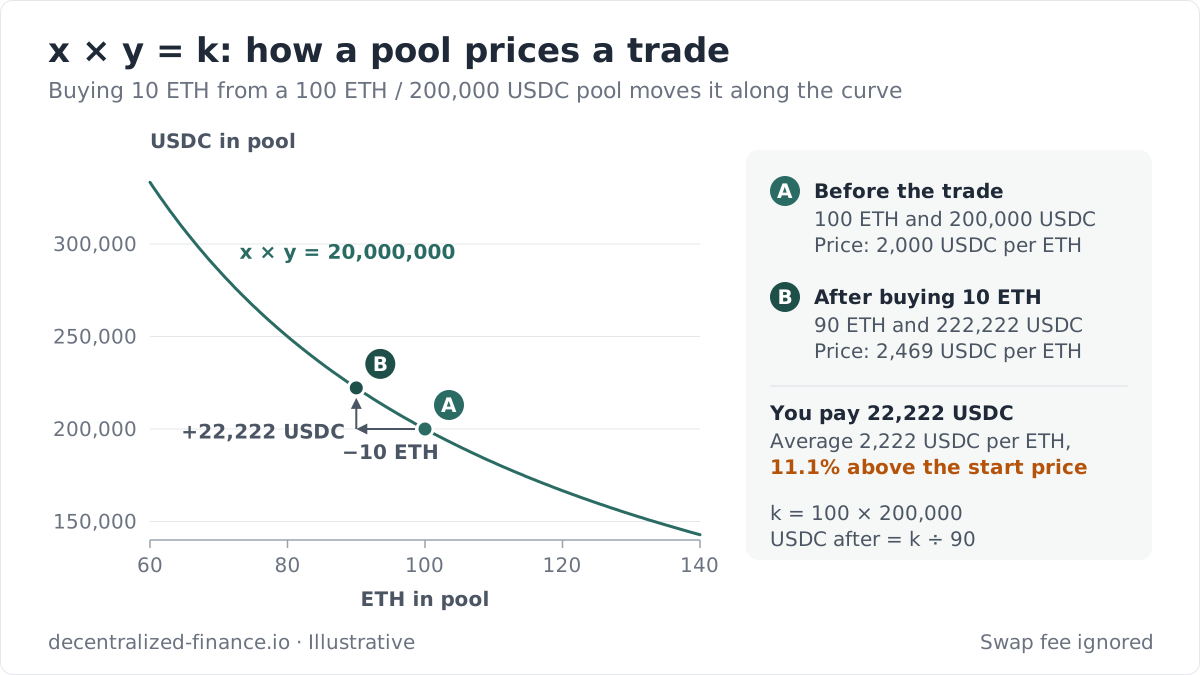
When you swap ETH for USDC on Uniswap, you are not trading with another person. You are trading with the ETH/USDC liquidity pool — a smart contract holding millions of dollars of both tokens. The pool uses a mathematical formula to calculate your exchange rate and execute the trade instantly.
How liquidity providers (LPs) work
Liquidity pools depend on users who deposit tokens — called liquidity providers or LPs. To deposit in a standard 50/50 AMM pool, you must provide equal values of both tokens. For example, depositing $5,000 into an ETH/USDC pool requires $2,500 of ETH and $2,500 of USDC.
In return, you receive LP tokens (ERC-20 tokens in v2-style pools) or a position NFT (Uniswap v3 and v4) representing your share of the pool. These LP tokens can be redeemed at any time for your proportional share of the pool's reserves (plus accumulated fees). Your pool share earns a fraction of every trade fee generated by the pool.
LP tokens are transferable and composable — many protocols allow you to stake your LP tokens to earn additional governance token rewards (liquidity mining), on top of the base trading fee income.
Types of liquidity pools
Not all liquidity pools work the same way. The DeFi ecosystem has evolved several pool types, each optimised for different assets and use cases.
- Constant product pools
- The original AMM design used by Uniswap V2. All liquidity covers the full 0-to-infinity price range, making it simple but capital-inefficient.
- Concentrated liquidity pools
- Uniswap V3 pools where LPs choose a specific price range for their liquidity, earning more fees per dollar but requiring active management.
- Stable pools (Curve)
- Optimised for pegged assets (stablecoins, liquid staking tokens) using the StableSwap formula, which minimises slippage near the peg.
- Weighted pools (Balancer)
- Multi-asset pools with custom weight ratios — for example, an 80% BTC / 20% ETH pool — allowing portfolio-like liquidity provision.
- Single-sided pools
- Protocols like Aave use single-asset 'pools' (supply markets) where users deposit one token and earn interest from borrowers.
Risks of providing liquidity
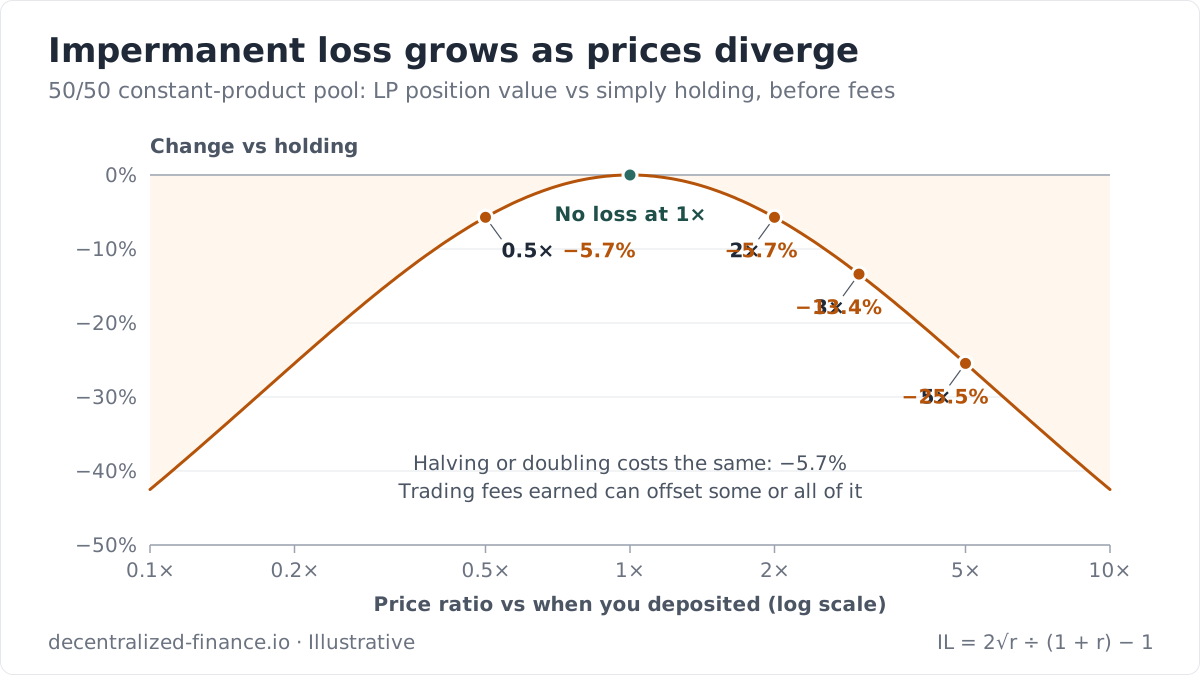
Providing liquidity is not risk-free. The main risks are: impermanent loss (the value difference between holding tokens vs holding the LP position as prices diverge), smart contract risk (bugs in the pool contract could lock or drain funds), and composability risk (additional protocols built on top of LP positions add extra smart contract layers).
For most standard pools on established protocols, the largest risk is impermanent loss. You can minimise it by choosing correlated asset pairs (ETH/stETH, USDC/USDT) where both tokens move similarly, or by selecting pools that generate sufficient fee income to compensate.
Always verify you are depositing into the official pool address — not a phishing imitation. Malicious pools have been deployed that steal deposits on confirmation. Use only official protocol interfaces or a verified address from on-chain explorers.
Liquidity pools beyond trading
Liquidity pools are not just for DEX trading. They underpin much of DeFi: Aave and Compound use lending pools where depositors supply tokens that borrowers borrow against collateral. Balancer pools can serve as treasuries for DAOs. Curve pools are used as pricing oracles by other protocols. The 'pool' concept — shared smart contract capital that anyone can interact with — is a foundational primitive of the DeFi ecosystem.
Sources
Primary documentation and data this guide relies on. Links checked .
- How Uniswap Works — Uniswap developer documentation. AMMs replace order books; pools of two tokens priced by x*y=k
- Pools (Uniswap v2) — Uniswap developer documentation. LPs deposit proportional pairs, receive pool tokens, earn pro-rata 0.3% fees, burn tokens to withdraw
- Curve AMM — Curve documentation. Curve stable pools use StableSwap for assets trading near parity
- Weighted Pools — Balancer documentation. Balancer multi-asset pools with custom weights such as 80/20
- Liquidity Pool — Aave documentation. Lending pools where suppliers deposit single assets that borrowers access
- Uniswap protocol TVL and volume — DeFiLlama. TVL as a measure of assets deposited in a protocol's pools
Frequently asked questions
How much can I earn as a liquidity provider?
LP earnings depend on pool fee tier and trading volume. High-volume pools (ETH/USDC on Uniswap) typically earn 5–30% APY from fees alone, though impermanent loss frequently offsets earnings. Stablecoin pairs earn lower fees (1–8% APY) but with minimal impermanent loss. LP returns are highly variable and past yields are not predictive of future returns.
Can I withdraw my liquidity at any time?
Yes — most AMM pools allow you to withdraw your proportional share of reserves at any time by redeeming your LP tokens. There are no lockup periods in standard AMMs. Some protocols (like Curve gauges or Balancer pools with lockups) may require you to unstake LP tokens before withdrawal, which may take a transaction or two but does not typically involve waiting periods.
What is liquidity mining?
Liquidity mining is when protocols incentivise LPs with governance or utility token rewards on top of trading fee income. These rewards are typically distributed proportional to your share of the pool. Liquidity mining can significantly boost LP APY but also carries the risk that the reward token loses value over time, eroding the real yield.
What is a 'rug pull' in liquidity pools?
A rug pull is when a protocol's developers drain the liquidity pool by removing their liquidity or exercising a backdoor in the smart contract, leaving other LPs with worthless tokens. Rug pulls most commonly target newly launched, unaudited protocols with high APY incentives. Protect yourself by only providing liquidity to audited protocols with locked or time-locked admin keys.
What is total value locked (TVL) and how does it relate to liquidity pools?
TVL (Total Value Locked) is the total dollar value of all assets deposited in a protocol's liquidity pools and smart contracts. It is the primary metric for measuring DeFi protocol size. A protocol with $10B TVL has $10B of crypto assets deposited across its pools. Higher TVL generally indicates a deeper, more liquid protocol with less price impact for large trades.