On this page (7 sections)
Who should skip this?
Skip Stargate if you are moving from Ethereum to an L2 (canonical deposits arrive in minutes) or can wait for a native L2 → Ethereum withdrawal (about 1–5 days on Base, about 7 days on Arbitrum and OP Mainnet), you cannot verify token contracts on the destination, or you have no gas token on the far chain. Pooled bridges fail differently from canonical ones — size the transfer as bridge risk.
- You only needed Ethereum → Base and can use a bridge listed in Base's docs
- You have zero native gas on the destination chain
- You are moving a life-changing sum you cannot afford to have stuck in a messenger
Should you use Stargate or an official L2 bridge?
Use Stargate when you need native USDC/USDT/ETH on another EVM chain without waiting for a rollup's challenge window. Use the official Arbitrum or Base bridge when you can wait and you want the canonical asset, not a pool IOU path.
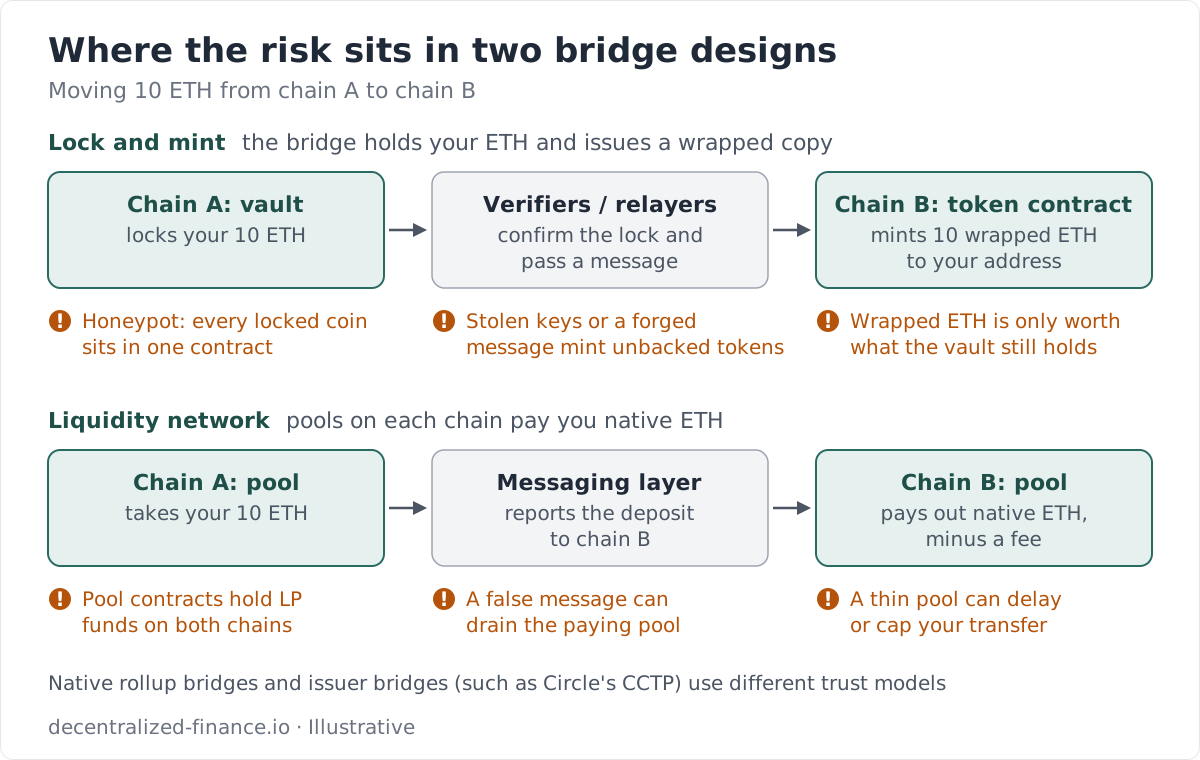
Stargate is a liquidity network plus LayerZero messages. Official L2 bridges are lock-and-mint with the rollup's own rules. They are not interchangeable. Wormhole vs Stargate is the right comparison if you are choosing messengers, not if you are depositing to Base for the first time.
Status, 25 September 2026: Stargate is now owned by the LayerZero Foundation, which acquired it in 2025, and the STG token has been retired — STG can be converted to ZRO only until 15 December 2026, after which LayerZero says conversions will not be supported. From 1 October 2026 all Stargate transfers are delivered by 'Taxi' (immediate delivery) and the batched 'Bus' mode ends. For Ethereum → Base, the old bridge.base.org interface has been deprecated; use a bridge listed in Base's docs. You do not need any token to bridge, and you should only follow STG conversion instructions linked from LayerZero's own site.
What is Stargate and how does it work?
Stargate holds pools of the same asset on multiple chains. A transfer burns or unlocks on the source and pays out from the destination pool (simplified). LayerZero carries the message. If the destination pool is thin, size is limited or the transfer waits. Official app: stargate.finance (checked August 2026).
You still need the destination chain's gas token. Bridging USDC to Arbitrum with zero ETH on Arbitrum leaves the USDC stranded until you acquire gas. That is the most common 'Stargate ate my funds' report, and it is usually user error.
| Stargate | Official OP/Arbitrum bridge | CEX withdraw | |
|---|---|---|---|
| Asset type | Pooled native stables/ETH | Canonical L2 ETH/tokens | Custodial until withdrawal |
| Exit speed | Minutes if liquidity exists | Slow native withdrawals | Exchange policy |
| Failure mode | Pool + messenger | Rollup bridge / sequencer | Exchange insolvency / freeze |
How do you send a first Stargate transfer?
Move a test amount you can lose to operational error. Confirm source chain, destination chain, token, and that you already hold gas on the destination — or bridge a little ETH first.
- 01
Open stargate.finance
Connect the wallet. Select source (e.g. Ethereum) and destination (e.g. Arbitrum). Pick USDC or ETH.
- 02
Read pool liquidity and fees
If the UI warns about liquidity, reduce size or pick another route. Note the fee versus a canonical bridge.
- 03
Confirm and wait
Approve the token if needed, sign the transfer, wait for LayerZero delivery (often minutes). Check the destination explorer, not only the source tx.
- 04
Verify the token contract
Scammers list fake 'bridged' tokens. Match the official USDC/USDT/ETH contract for that chain.
Never bridge your entire net worth through any pooled messenger on the first try. Canonical rollup bridges are slower and still not 'safe' in the bank sense — they are a different risk.
The verdict: should you use Stargate?
Yes, for routine native stablecoin moves across EVM chains when you have checked liquidity and destination gas. No, as your first-ever L2 onboarding — use Arbitrum's official bridge or a bridge listed in Base's docs for that lesson. No, for amounts you cannot expose to bridge smart contracts.
If you are choosing among messengers, read Wormhole vs Stargate. If you only needed Base, the Base bridge guide is the shorter path.
Sources
Primary documentation and data this guide relies on. Links checked .
- Ecosystem Update - 9/15/26 — LayerZero. STG-to-ZRO conversion deadline and changes to Stargate transfer modes
- Overview (What's New in Stargate V2) — Stargate documentation. How Stargate works: pooled liquidity across chains, Hydra chains, LayerZero messaging
- Fees — Stargate documentation. Step 'Read pool liquidity and fees': what a Stargate transfer costs
- Transfer — Stargate documentation. First-transfer steps and why a transfer may wait (batched Bus vs Taxi)
- Security Stack (DVNs) — LayerZero documentation. FAQ 'Is Stargate the same as LayerZero?': messaging layer and who verifies messages
- Inside the KelpDAO Bridge Exploit — Chainalysis. Pooled/messenger bridge risk: recent LayerZero-based bridge exploit via verifier misconfiguration
- LayerZero Proposes $110M Stargate Token Merger in Consolidation Play — CoinDesk. FAQ 'What is STG?': STG retired as a standalone governance/rewards token
Frequently asked questions
Stargate vs official L2 bridges?
Official bridges mint the canonical L2 asset and often have slow native withdrawals. Stargate uses pooled liquidity for faster native transfers when pools are deep. Faster is not safer.
What is STG?
STG was Stargate's governance token, but it has been retired: the LayerZero Foundation acquired Stargate in 2025, and STG can be converted to ZRO only until 15 December 2026. You do not need any token to bridge. Providing liquidity is a separate, risky job from transferring once.
Why did my transfer not arrive?
Common causes: waiting on LayerZero verification and delivery, thin destination liquidity, or checking the wrong chain/token. (Delays from batched 'Bus' transfers end on 1 October 2026, when every transfer moves to immediate 'Taxi' delivery.) Use the official explorer links from the Stargate UI. Support cannot reverse a completed pool payout to a wrong address you typed.
Is Stargate the same as LayerZero?
LayerZero is the messaging layer. Stargate is an application that uses it plus liquidity pools. A LayerZero message succeeding is necessary but not the whole story — the pool must also pay out. Messages are also only as secure as the set of verifiers (DVNs) each application configures: in April 2026 attackers took about $292 million from KelpDAO's LayerZero-based rsETH bridge, which relied on a single verifier.