On this page (7 sections)
Who should skip this?
Skip Lido if you can run a validator and want no extra contract risk, you needed a CEX staking button, or you cannot explain stETH depeg risk. Lido is liquid staking. stETH is not ETH until you exit or redeem.
- You wanted native solo staking with 32 ETH and no LST
- You cannot tolerate smart-contract or validator-set risk
- You needed a CeFi earn product with a help desk
What Lido does and how it works
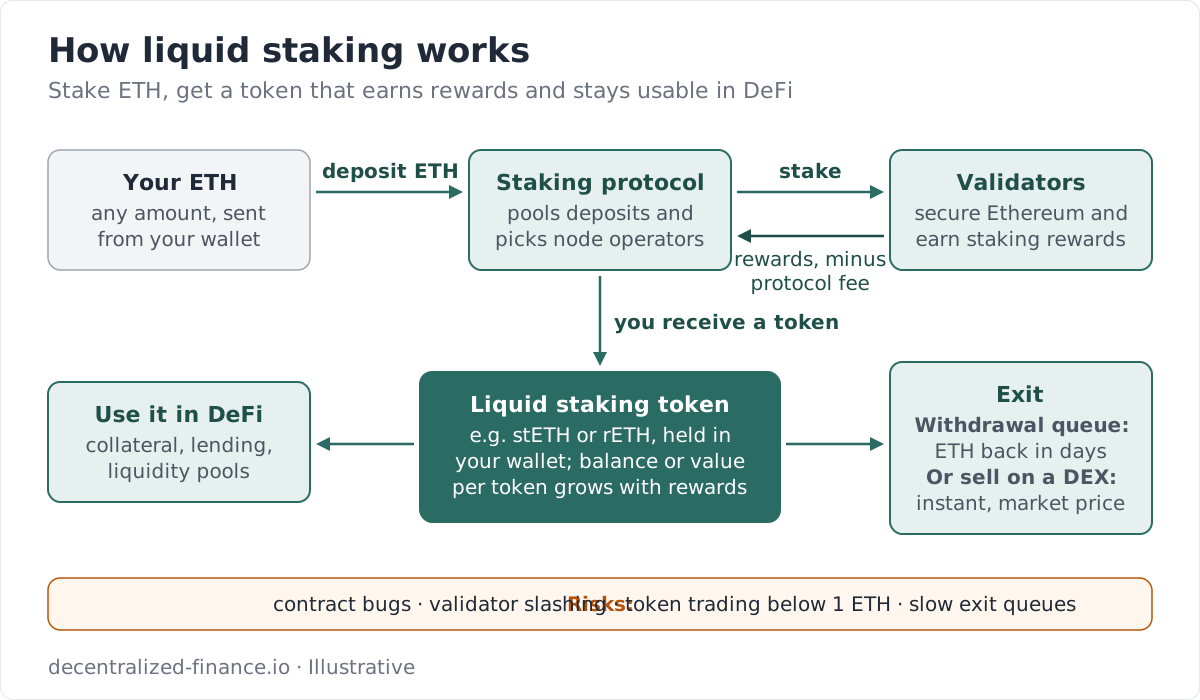
Lido is a liquid staking protocol that lets you participate in Ethereum's proof-of-stake consensus mechanism without running a validator node yourself (which requires exactly 32 ETH and technical infrastructure). Lido pools user deposits, distributes them across a network of professional validator operators, and issues stETH tokens representing your staked ETH.
stETH is a rebasing token — its balance in your wallet automatically increases daily to reflect accumulated staking rewards. If you stake 1 ETH and hold stETH for a year at about 2.2% APR (roughly the rate in September 2026), you will have approximately 1.022 stETH without taking any action.
Step-by-step: Staking ETH with Lido
- 01
Set up your wallet
Ensure you have a compatible wallet (MetaMask, Rabby, Coinbase Wallet, or Ledger via WalletConnect) with ETH on Ethereum mainnet. You need the amount you wish to stake plus a little extra ETH for gas (typically well under $1 per transaction on mainnet as of September 2026, more when the network is congested).
- 02
Go to stake.lido.fi
Visit stake.lido.fi in your browser. Always verify the URL — the official Lido staking interface is stake.lido.fi. Bookmark it to avoid phishing sites. Do not use search engine ads to find the Lido interface.
- 03
Connect your wallet
Click 'Connect wallet' and select your wallet provider. Approve the connection request in your wallet. You will see your ETH balance displayed in the staking interface.
- 04
Enter staking amount
In the 'Stake' field, enter the amount of ETH you want to stake. There is no minimum. The interface will show you how much stETH you will receive (1:1 ratio) and the current staking APR. Leave a small amount of ETH in your wallet for gas — as of September 2026 a mainnet stake transaction typically costs well under $1, though fees spike during congestion.
- 05
Click Stake and confirm
Click the 'Stake' button. Your wallet will prompt you to confirm the transaction. Review the gas fee estimate — this is a one-time cost. Confirm in your wallet. The transaction typically takes 10-30 seconds on Ethereum mainnet.
- 06
Add stETH to your wallet display
After staking, your stETH balance may not appear automatically in your wallet. To see it, add stETH as a custom token using the contract address 0xae7ab96520DE3A18E5e111B5EaAb095312D7fE84. In MetaMask, go to 'Import tokens' and paste the address.
- 07
Monitor your staking rewards
Visit stake.lido.fi and connect your wallet to see your staking rewards accumulating. Rewards are distributed in the form of additional stETH credited to your balance — typically daily, visible as your stETH balance slowly increasing.
How to unstake (convert stETH back to ETH)
Since the Shapella upgrade (April 2023), Ethereum validator withdrawals are fully enabled and Lido has a native withdrawal mechanism. On stake.lido.fi, click 'Unstake', enter your stETH amount, and submit. The unstaking queue can take 1-5 days depending on Ethereum's withdrawal queue length.
Alternatively, you can swap stETH for ETH instantly via DEXes like Curve or a DEX aggregator like 1inch. The stETH/ETH rate on Curve is typically very close to 1:1 with minimal slippage. Swapping is faster than native withdrawal but may have slightly worse pricing during market stress.
stETH is widely accepted as collateral on lending protocols (Aave, Morpho) and can be used in Curve and Pendle liquidity pools. Holding stETH is often more capital-efficient than holding unstaked ETH because you earn staking yield while keeping the ETH deployed in DeFi.
Lido fees and staking yield
Lido charges a 10% fee on staking rewards — this is automatically deducted from the staking yield before distribution to stETH holders. For example, if staking rewards were 2.5% APR gross, you would receive about 2.25% APR net after Lido's fee (stETH's 7-day average APR was about 2.24% in late September 2026). How the fee is split depends on the staking module — in the Curated Module, for example, 5% goes to node operators and 5% to the Lido DAO treasury. There are no deposit or withdrawal fees beyond Ethereum gas.
- Compare Lido's net APR with alternatives: Rocket Pool (rETH) has slightly lower yield but is more decentralised; EtherFi (eETH/weETH) now pays plain staking yield — it has wound down EigenLayer restaking for these tokens
- stETH rebasing means it works differently in some DeFi protocols — use wstETH (wrapped stETH) for protocols that do not support rebasing tokens
- Monitor Lido's validator performance through the protocol stats and validator metrics pages linked from lido.fi — slashing events (rare) reduce stETH value
Sources
Primary documentation and data this guide relies on. Links checked .
- Introduction — Lido documentation. 10% fee on rewards and net APR = protocol APR × (1 − fee)
- Mainnet (deployed contracts) — Lido documentation. Official stETH contract address for importing the token into a wallet
- How long does an Ethereum withdrawal take? — Lido Help Center. Unstaking via Lido's withdrawal queue normally takes 1–5 days
- Lido Tokens Integration Guide — Lido documentation. stETH rebasing vs wstETH; which token to use in DeFi and bridge to L2s
- Protocol Fee — Lido. How the 10% fee splits between node operators and the DAO treasury
- Lido on Polygon Sunset — Lido blog. FAQ on other networks: Lido on Polygon (stMATIC) has been discontinued
- Staking withdrawals — ethereum.org. Validator withdrawals enabled since the Shanghai/Capella (Shapella) upgrade
Frequently asked questions
Is there a minimum amount of ETH to stake with Lido?
No minimum — you can stake any amount of ETH with Lido, including fractions of ETH. This makes Lido accessible to all holders, unlike running an Ethereum validator which requires exactly 32 ETH (approximately $50,000-100,000 depending on ETH price).
What is the difference between stETH and wstETH?
stETH is a rebasing token — its balance increases over time as rewards accrue. wstETH (wrapped stETH) is a non-rebasing version with a stable token count that appreciates in value instead. Some DeFi protocols (like Aave) use wstETH rather than stETH because rebasing tokens require special accounting. Lido's interface lets you wrap and unwrap between them.
Can I lose my ETH by staking with Lido?
Validator slashing (penalisation for misbehaviour by Lido's node operators) could reduce the stETH/ETH ratio — though Lido has a coverage fund to partially compensate. Smart contract bugs in Lido's contracts are the main catastrophic risk. Lido has operated since 2020 with no major exploits, has undergone many audits, and is the most battle-tested liquid staking protocol.
How is Lido different from staking directly on Coinbase or Binance?
Lido is a non-custodial protocol — you never give up control of your assets, and stETH remains in your own wallet. Centralised exchange staking (Coinbase cbETH, Binance BETH) is custodial — the exchange holds your ETH. Non-custodial staking means no counterparty risk from the exchange, but does introduce smart contract risk from Lido's protocol.
What networks can I stake ETH on via Lido?
Lido's primary staking product is on Ethereum mainnet (where the actual validator staking occurs). To use your staked ETH on Layer 2 networks, use wstETH rather than stETH: Lido warns that bridging stETH itself prevents you from collecting staking rewards and asks users to bridge only wstETH. The staking itself always happens on Ethereum mainnet. Lido's Solana and Polygon products have been sunset — Lido on Solana stopped accepting stake in October 2023, and Lido on Polygon was discontinued in December 2024, with front-end withdrawals ending in June 2025 — so Lido staking is now Ethereum only.