On this page (8 sections)
Who should skip this?
Skip this explainer if you already hold stETH or JitoSOL and understand depeg risk, or you wanted a CEX staking button. Liquid staking is a token plus validator risk. The Lido or Marinade how-to is the next tab if you are ready to transact.
- You wanted native 32 ETH solo staking only
- You cannot tolerate smart-contract risk on top of validators
- You needed a savings account with insurance
Why regular ETH staking has a problem
Ethereum moved from proof-of-work to proof-of-stake in September 2022 (The Merge). Validators secure the network by staking ETH as collateral and earn rewards in return — about 2.6% a year gross across the network in September 2026 (Lido's stETH paid about 2.2% after its fee). But native Ethereum staking has significant barriers: you need at least 32 ETH to activate a validator (about £65,000 at September 2026 prices; since the Pectra upgrade a validator can hold up to 2,048 ETH), technical expertise to run a validator node, and you must accept that staked ETH was locked until the Shanghai upgrade (April 2023).
Even after withdrawals were enabled, native staking remains complex and capital-intensive for most users. Liquid staking protocols solve both problems.
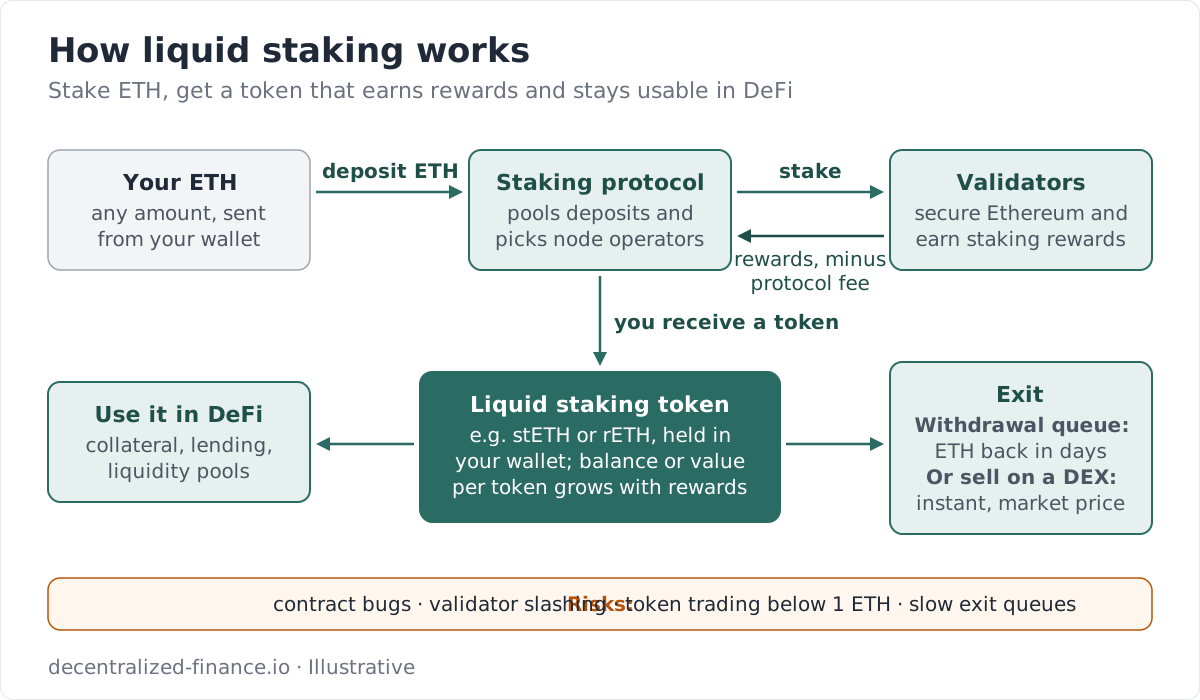
How liquid staking works
- 01
Deposit ETH into the protocol
You send ETH to a liquid staking protocol like Lido or Rocket Pool. There is no minimum for Lido (as little as 0.01 ETH works in practice), and 0.01 ETH minimum for Rocket Pool.
- 02
Receive a liquid token
The protocol gives you a receipt token representing your staked ETH: stETH from Lido, rETH from Rocket Pool, weETH from EtherFi. This token is an ERC-20 — it lives in your wallet and can be transferred, traded, or used in DeFi.
- 03
Rewards accrue automatically
Your receipt token increases in value over time (rETH, weETH) or your balance increases daily (stETH). You do not need to do anything — rewards from the underlying validators are passed through to token holders, minus the protocol's fee (typically 10% of rewards).
- 04
Use the token in DeFi
While your ETH earns staking rewards, your liquid token can simultaneously be used elsewhere: deposit stETH into Aave as collateral to borrow stablecoins, add it to a Curve liquidity pool for additional yield, or simply hold it as productive collateral.
- 05
Exit when you want
Redeem your liquid token for ETH through the protocol's withdrawal mechanism (subject to queue times) or sell it on a DEX like Uniswap or Curve, which gives instant liquidity at a small discount/premium.
Lido vs Rocket Pool vs EtherFi compared
Lido is the largest single staking provider, with about 22–23% of all staked ETH (roughly 9.8M of 43.2M ETH staked, September 2026) — which is both a sign of trust and the source of its biggest criticism. A single protocol controlling that much of Ethereum's staking introduces systemic risk and raises decentralisation concerns. The Ethereum community has actively discussed whether Lido's dominance is healthy for the network.
Rocket Pool takes a different approach: since its Saturn I upgrade (February 2026), anyone can run a node with a 4 ETH bond per validator, and staking RPL is optional — making it more decentralised but also more complex. rETH tends to trade at a premium to ETH because it is scarcer.
EtherFi grew quickly on native restaking via EigenLayer, but it has since wound that down: its docs say eETH and weETH no longer bundle restaking rewards or EigenLayer slashing exposure, with under 1% of assets still restaked in August 2026 and 0% planned by the end of Q3 2026. Restaking at EtherFi is now a separate opt-in product (weETHs).
| Protocol | Token | Minimum | Reward model | Decentralisation | Fee |
|---|---|---|---|---|---|
| Lido | stETH | No minimum | Rebasing (balance grows daily) | Curated operators plus a permissionless, bonded Community Staking Module | 10% of rewards |
| Rocket Pool | rETH | ~0.01 ETH | Exchange rate (token appreciates) | Permissionless node operators (4 ETH bond since Saturn I) | ~14% of rewards |
| EtherFi | eETH / weETH | No minimum | eETH rebasing; weETH exchange rate | Plain staking — EigenLayer restaking wound down (opt-in weETHs for restaking) | 10% of rewards |
| Frax Ether | frxETH | No minimum | Dual token model | Permissioned + Frax ecosystem | ~10% of rewards |
Risks of liquid staking
Liquid staking is not risk-free. Understanding the risks is essential before committing capital:
- Smart contract risk: If the protocol's smart contracts have a bug, funds could be lost. All major protocols have been audited, but no code is perfectly safe.
- Validator slashing risk: If a node operator behaves badly (double-signing, downtime), their staked ETH is 'slashed' (partially destroyed). Most protocols insure against this from their treasury, but large-scale slashing events could exceed reserves.
- Depeg risk: Liquid staking tokens can trade below their ETH value during market stress. stETH famously fell to ~0.94 ETH during the June 2022 crisis. If you need to sell during a depeg, you receive less ETH than you deposited.
- Liquidity risk: Withdrawing directly from the protocol can take days to weeks depending on the withdrawal queue length on the beacon chain.
- Concentration risk: Lido's roughly 23% share of staked ETH means a critical vulnerability in Lido could have Ethereum-wide consequences.
What is restaking? (EigenLayer and beyond)
Restaking is a new concept where already-staked ETH is used to secure additional protocols beyond Ethereum itself. EigenLayer is the leading restaking protocol — users deposit stETH or native ETH into EigenLayer and opt into securing AVSs ('Autonomous Verifiable Services', originally 'Actively Validated Services'), earning additional rewards in return.
Kelp, Renzo, and Puffer Finance are liquid restaking protocols (LRTs) — they wrap EigenLayer restaking into a liquid token, giving users points and yield from multiple sources simultaneously. (EtherFi's main eETH/weETH tokens no longer restake; see above.)
Restaking amplifies both potential rewards and potential risks. If an AVS is attacked or behaves incorrectly, restakers could be slashed. This is a newer, less battle-tested risk layer on top of liquid staking.
staking rewards are considered income in most jurisdictions and may be subject to income tax in the year they are received. Consult a tax professional familiar with crypto for your specific situation.
Sources
Primary documentation and data this guide relies on. Links checked .
- Introduction — Lido documentation. Lido's 10% fee on staking rewards and how stETH holders' APR is derived
- Liquid & pooled staking — ethereum.org. Liquid staking tokens let users stake any amount; solo staking needs 32 ETH
- weETH / eETH — ether.fi documentation. EtherFi token mechanics; eETH/weETH no longer bundle EigenLayer restaking
- Saturn I Upgrade — Rocket Pool. Rocket Pool node-operator bond and RPL collateral requirements (minipool operator paragraph)
- Slashing on Mainnet is Coming Soon - What You Need to Know — Eigen Labs. Restaking section and FAQ on EigenLayer withdrawal delay
- Detecting Depegs: Towards Safer Passive Liquidity Provision on Curve Finance — arXiv (Cintra & Holloway). stETH depeg risk during the 2022 market stress
- Lido — DeFiLlama. Live Lido TVL behind the 'value secured' and market-share figures
Frequently asked questions
Is liquid staking safe?
Liquid staking with established protocols like Lido and Rocket Pool carries meaningful but manageable risk for users comfortable with DeFi. Both protocols have been operating since 2020/2021, have undergone numerous audits, and together held about $28 billion in TVL in September 2026 (DeFiLlama). The main risks are smart contract bugs, validator slashing, and stETH depegging events. Using well-audited protocols and understanding the risks before depositing is the right approach.
Can I lose my ETH in liquid staking?
In normal circumstances, no — you receive your ETH back (plus rewards) when you redeem. The risk scenarios where you could lose ETH are: a smart contract exploit draining protocol funds (very unlikely with major protocols due to audits and bug bounties), catastrophic mass slashing that exceeds protocol insurance (also very unlikely), or buying the liquid token on a DEX and selling it during a depeg event for less ETH than you paid.
What's the difference between stETH and wstETH?
stETH is a rebasing token — your balance grows daily as rewards accumulate. This causes issues with some DeFi protocols that do not handle rebasing well. wstETH (wrapped stETH) is the same underlying position converted to a non-rebasing format where the exchange rate increases instead of the balance. Most DeFi protocols use wstETH rather than stETH for this reason. They represent the same thing in different forms.
How long does it take to withdraw from liquid staking?
Selling on a DEX (Uniswap, Curve) is instant. Requesting a withdrawal directly from Lido or Rocket Pool typically takes 1–5 days depending on the validator exit queue on the Ethereum beacon chain. During periods of high withdrawal demand, this can stretch longer. EigenLayer withdrawals take 14 days after being queued (since slashing went live on mainnet in April 2025).
Do I need to pay taxes on liquid staking rewards?
In most major jurisdictions (US, UK, EU), staking rewards are treated as ordinary income in the year received, valued at the market price when received. Additionally, converting stETH back to ETH is typically a taxable disposal event. DeFi tax is complex and highly jurisdiction-specific — consult a qualified accountant or tax lawyer who specialises in crypto.