On this page (8 sections)
Who should skip this?
Skip this explainer if you already know canonical versus pooled bridges, or you wanted a single-route how-to. Use the Base or Stargate guides when you are ready to move funds. Bridges fail differently from AMMs.
- You wanted a click-path for one destination chain
- You cannot afford a test transfer
- You needed a CEX withdrawal instead of a bridge
Why bridges are necessary
Different blockchains are separate, isolated systems. Ethereum cannot natively see what is on Solana, and Bitcoin cannot interact with DeFi protocols on Polygon. Each blockchain is like a country with its own currency — bridges are the exchange offices that let you move value between them.
As DeFi expanded from Ethereum to dozens of other chains (Arbitrum, Optimism, Base, BNB Chain, Avalanche, Solana, Polygon, and more), the need to move assets between them grew. You might want to use a protocol only available on Arbitrum while holding assets on Ethereum, or take advantage of lower fees on a Layer 2 while your ETH is on mainnet.
How bridges work: the basic mechanism
- 01
Lock or burn on the source chain
You send your tokens to the bridge's smart contract on the source chain (e.g., Ethereum). The bridge either locks them in the contract (lock-and-mint model) or burns them permanently (burn-and-mint model).
- 02
Relay the message to the destination chain
The bridge's infrastructure (which varies by type — see below) verifies that the lock/burn happened on the source chain and relays this information to the destination chain.
- 03
Mint or release on the destination chain
The bridge mints an equivalent amount of a 'wrapped' token on the destination chain, or releases tokens from a pool already held there. You receive your bridged tokens in your wallet on the destination chain.
- 04
Bridging back
To return, you burn or lock the bridged tokens on the destination chain, and the original tokens are unlocked or minted back on the source chain. The process runs in reverse.
Types of bridges
- Lock-and-mint bridges
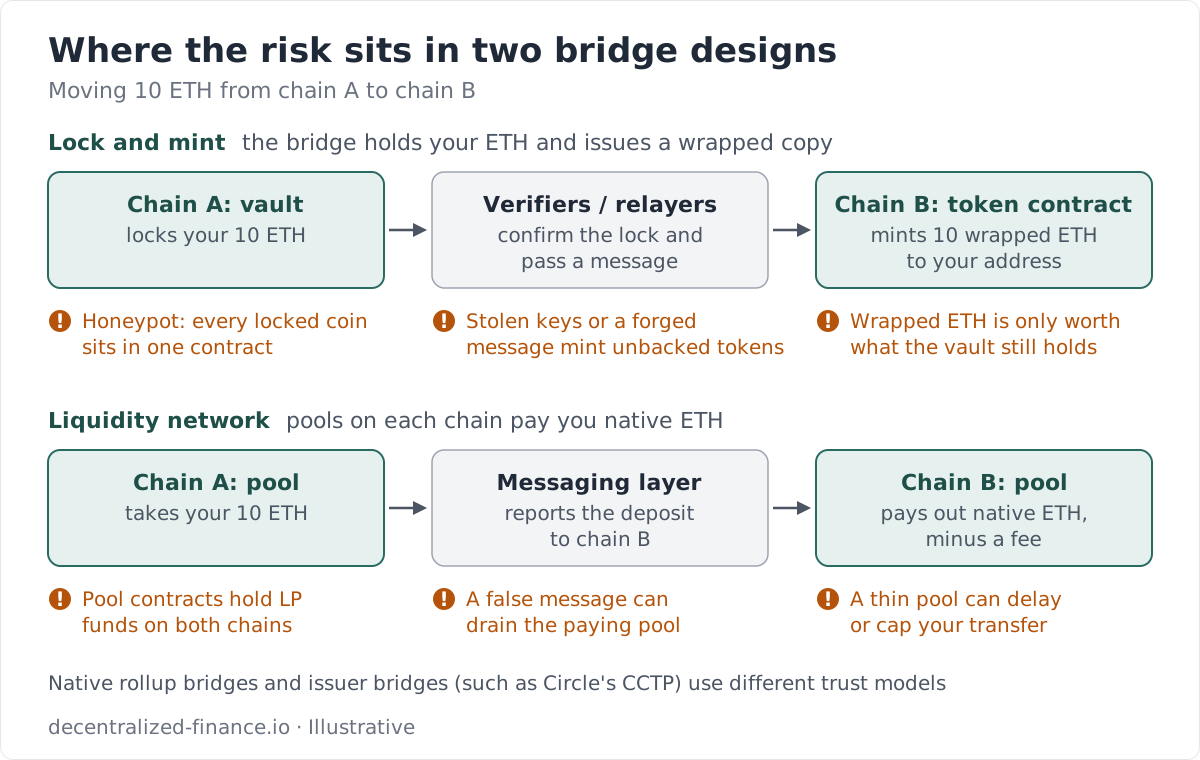
- The original model. Lock assets in a smart contract on chain A, mint wrapped versions on chain B. The wrapped token (e.g., WBTC on Ethereum) represents the locked original. Risk: the locked assets on chain A become a massive target for hackers — if the smart contract is compromised, all bridged assets can be stolen.
- Liquidity network bridges
- Instead of locking and minting, these use pools of native assets on both chains. When you bridge, you deposit into the pool on chain A and withdraw native assets from the pool on chain B. Faster and no wrapped tokens, but requires liquidity to be pre-seeded on both sides. Stargate, Hop Protocol, and Across use this model.
- Native chain bridges
- The canonical bridge contracts built by the Layer 2 networks themselves (for example the Arbitrum Bridge; Base retired its own bridge.base.org interface and now lists third-party bridges such as Superbridge and Brid.gg in its docs). These are the most secure because they are built into the rollup's own security model. Trade-off: withdrawals back to Ethereum mainnet take about 1–7 days depending on the rollup — about 7 days on Arbitrum and OP Mainnet, and about 1–5 days on Base since June 2026.
- Canonical token bridges
- Bridges operated by the token issuer themselves (e.g., Circle's CCTP for USDC). These burn USDC on the source chain and mint native USDC on the destination — you get the real USDC, not a wrapped version. Very safe for supported tokens.
Bridge security: why bridges get hacked
Bridges are the most-hacked category in DeFi. By March 2024, over $2.5 billion had been stolen from bridge exploits, and the losses have continued: in April 2026 attackers took about $292 million in rsETH from KelpDAO's LayerZero-based bridge by attacking its off-chain verification set-up. The reason is straightforward: lock-and-mint bridges concentrate enormous value in a single smart contract, making them the highest-value targets in crypto.
| Bridge | Year | Amount Stolen | Attack Type |
|---|---|---|---|
| Ronin Network (Axie) | 2022 | $625 million | Private key compromise |
| BNB Chain Bridge | 2022 | ~$570–586 million minted (2M BNB); ~$127 million escaped | Forged proof exploit |
| Wormhole | 2022 | $320 million | Signature verification bug |
| Nomad | 2022 | $190 million | Initialisation bug (copycat exploit) |
| Multichain | 2023 | $126 million | Unexplained MPC-key withdrawals (suspected key compromise or insider) |
| KelpDAO rsETH (LayerZero route) | 2026 | ~$292 million | Off-chain infrastructure attack on a single-verifier (1-of-1 DVN) set-up |
Avoid holding large amounts of funds in bridge smart contracts for longer than necessary. Bridges are infrastructure, not storage — move quickly and move on.
Which bridge should you use?
- For Ethereum ↔ Arbitrum/Optimism/Base: Use the official native bridge — it is the most secure option, though slow for withdrawals back to Ethereum
- For fast bridging with good security: Stargate, Across, and Hop are well-audited liquidity bridges with strong track records
- For USDC specifically: Circle's CCTP (native USDC bridge) gives you true USDC on the destination chain, not a wrapped version
- Always check the bridge's audit history and TVL before using a newer or lesser-known bridge
- Never use unaudited bridge contracts that appear in ads or social media DMs — bridge scams are extremely common
Sources
Primary documentation and data this guide relies on. Links checked .
- Introduction to blockchain bridges — ethereum.org. Why bridges exist, native L2 bridges, wrapped tokens and trusted vs trustless designs
- Cross-Chain Bridge Hacks Emerge as Top Security Risk — Chainalysis. 'Bridges are the most-hacked category'; billions lost to bridge exploits
- Ronin Network - REKT — rekt.news. Hack table: Ronin 2022, about $624M, compromised validator private keys
- Wormhole - REKT — rekt.news. Hack table: Wormhole 2022, about $326M, signature-verification bug
- Nomad Bridge - REKT — rekt.news. Hack table: Nomad 2022, ~$190M, copycat exploit
- BNB Bridge - REKT — rekt.news. Hack table: BNB Chain bridge 2022 forged-proof exploit and real loss size
- Multichain - REKT 2 — rekt.news. Hack table: Multichain 2023, ~$126M
Frequently asked questions
Is bridging crypto taxable?
It depends on the jurisdiction and bridge type. For lock-and-mint bridges, the original asset still belongs to you — many tax authorities consider this a non-taxable transfer rather than a disposal, similar to moving cash between bank accounts. However, if you receive a different token (e.g., wrapped USDC instead of native USDC), some jurisdictions treat this as a swap (taxable disposal). Consult a crypto tax professional for clarity in your jurisdiction.
How long does bridging take?
Bridging to an L2 (Arbitrum, Optimism, Base) via the native bridge takes about 10–20 minutes. Bridging back to Ethereum via the native bridge takes about 7 days on Arbitrum and OP Mainnet, and about 1–5 days on Base since its June 2026 Beryl upgrade, because of each rollup's proof window. Third-party bridges (Stargate, Across, Hop) offer faster withdrawals in both directions — typically 1–30 minutes — at the cost of a small fee and slightly more trust in the bridge infrastructure.
What is a 'wrapped' token?
A wrapped token (e.g., WETH, WBTC, wrapped USDC) is a representation of an original asset on a chain that does not natively support it. WBTC is Bitcoin represented on Ethereum as an ERC-20 token — you can use it in Ethereum DeFi while your actual Bitcoin is locked in custody. Wrapped tokens introduce the risk that the custodian (or smart contract) holding the original assets could be compromised.
Can I bridge any token?
Most major tokens can be bridged between Ethereum and major L2s and alt-L1s. However, liquidity and support varies significantly. Large, liquid tokens (ETH, USDC, USDT, WBTC) can be bridged cheaply and quickly. More obscure tokens may have limited bridging options, wide spreads, or no support at all on your target chain. Check the bridge's interface for supported tokens before assuming a path exists.