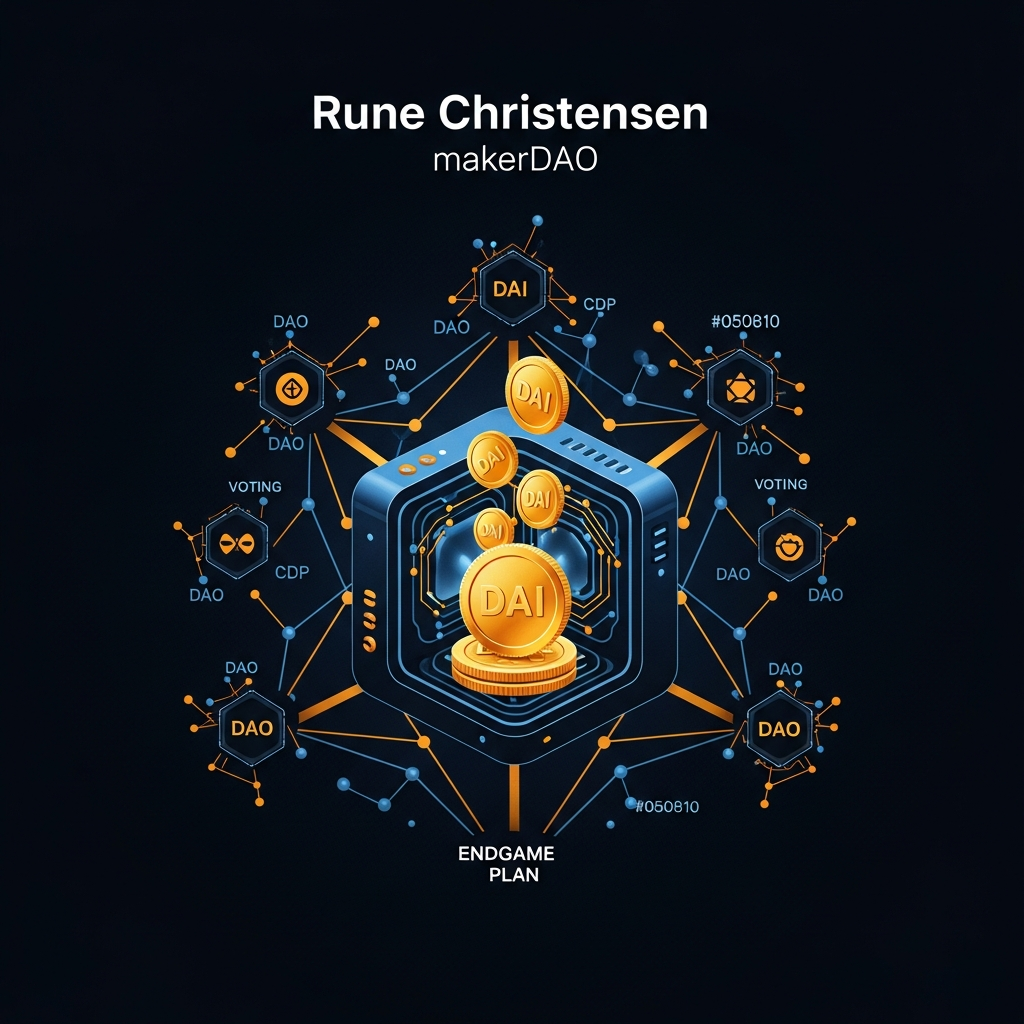
Rune Christensen
Founder of MakerDAO
Rune Christensen is a Danish entrepreneur and the founder of MakerDAO — the decentralised autonomous organisation behind DAI, one of the oldest and most widely used decentralised stablecoins — and the architect of the Endgame Plan that is reshaping Maker's governance structure as Sky.
In this profile
Rune Christensen is a Danish entrepreneur and the founder and CEO of Maker Foundation — the organisation that incubated and built MakerDAO into one of the most consequential protocols in decentralised finance. Christensen founded MakerDAO in 2014, before Ethereum had even launched, and spent years building the protocol and its governance structures before the first version of DAI — a decentralised stablecoin backed by collateralised crypto positions — went live in December 2017.
Christensen's background before MakerDAO included studies in biochemistry and international business, and entrepreneurial ventures in e-commerce. He became interested in Bitcoin around 2011 and recognised early that a decentralised stablecoin — a cryptocurrency that held its value relative to fiat without being issued or controlled by a centralised entity — was a fundamental missing piece in the digital asset ecosystem. Most cryptocurrencies were too volatile to serve as a unit of account or medium of exchange; a stable, decentralised currency could enable an entirely new category of financial applications.
Building DAI and MakerDAO
The MakerDAO system that launched in 2017 — Single-Collateral DAI, backed only by ETH — was the culmination of years of design work and community development. The core mechanism was the Collateralised Debt Position (CDP): a user would lock ETH in a smart contract and receive DAI in return, with the amount of DAI capped at a percentage of the ETH's value. The overcollateralisation meant that DAI remained backed even if ETH's price declined — and if it declined too much, an automated liquidation process would repay the DAI by selling the ETH collateral.
The MKR token — MakerDAO's governance token — served a dual purpose: MKR holders voted on risk parameters, collateral types, and system upgrades, and MKR was the 'lender of last resort' for the system. If the collateral backing DAI ever proved insufficient to cover all outstanding DAI — a scenario called a 'black swan' — new MKR would be minted and sold to cover the shortfall, diluting existing MKR holders. This created a direct economic incentive for MKR holders to govern the system prudently.
The transition to Multi-Collateral DAI in November 2019 expanded the collateral base beyond ETH and introduced the DAI Savings Rate (DSR) — an interest rate on deposited DAI funded by stability fee income — giving DAI holders a reason to hold DAI beyond its utility as a stablecoin.
Real-World Assets and DeFi Integration
Under Christensen's direction, MakerDAO became one of the first DeFi protocols to aggressively integrate real-world assets as collateral and revenue sources. Beginning in 2020 and accelerating through 2022 and 2023, Maker began holding US Treasury bills, corporate bonds, and other fixed-income instruments through institutional wrappers and trust structures. The RWA portfolio generated substantial yield for the Maker system — at points exceeding $100 million annually — funded by interest on government securities rather than on-chain crypto activity.
This strategy was both profitable and controversial: it made DAI partially dependent on the solvency and goodwill of traditional financial institutions and governments, undermining the censorship-resistance guarantees that many DeFi users valued in decentralised stablecoins. Christensen navigated these debates through governance forums, articulating a position that practical utility and capital efficiency required some engagement with the traditional financial system.
The Endgame Plan and Sky
In 2022, Christensen published the 'Endgame Plan' — a sweeping proposal to restructure MakerDAO's governance, tokenomics, and product architecture. The plan introduced 'MetaDAOs' (later 'SubDAOs' and then 'Sky Stars') — semi-autonomous governance units each responsible for specific product lines within the Maker ecosystem. It also proposed rebranding the core DAI token to USDS (Sky Dollar) and the MKR token to SKY, with migration mechanics allowing MKR holders to convert their tokens.
The Endgame Plan represented Christensen's vision of a more scalable decentralised governance structure — one that avoids the paralysis of large-scale DAO voting by delegating decisions to smaller, focused groups while maintaining alignment through shared tokenomics. The rebrand to Sky completed in 2024, making Christensen one of the few DeFi founders to successfully execute a full ecosystem rebrand of a protocol with billions of dollars in TVL while maintaining user trust and liquidity.
Rune Christensen: Frequently Asked Questions
Who is Rune Christensen?
Rune Christensen is a Danish entrepreneur and the founder of MakerDAO — the decentralised autonomous organisation behind DAI, one of the oldest and most widely used decentralised stablecoins — and the architect of the Endgame Plan that is reshaping Maker's governance structure as Sky.
What is Rune Christensen known for?
Founding MakerDAO (2014), Creating DAI, the first major decentralised stablecoin (2017), Pioneering Collateralised Debt Positions (CDPs), Integrating real-world assets into DeFi through Maker, Authoring the Endgame Plan and Sky rebrand
What is Rune Christensen's role in DeFi?
Rune Christensen is Founder of MakerDAO. Rune Christensen is a Danish entrepreneur and the founder and CEO of Maker Foundation — the organisation that incubated and built MakerDAO into one of the most consequential protocols in decentralised finance. Christensen founded MakerDAO in 2014, before Ethe